
The short answer
Yes, a tree over or near power lines can be removed safely — it just needs the right machine and a crew who work near live lines every week. Energy Safe Victoria sets three clearance zones around an overhead line: outside 6.4 metres, no special requirements; between 3.0 and 6.4 metres, a registered spotter is required; inside 3.0 metres, the network operator’s permission is required. We use our own insulated elevated work platforms for anything inside those zones.
A tree that’s grown up close to the wires is one of the more common reasons people put off a removal — understandably, since it’s not a job for a ladder and a chainsaw. Here’s how it actually works when the tree is over or near a power line, and why the machine matters more than anything else on this particular job.
The three clearance zones
Energy Safe Victoria sets out three zones around an overhead distribution powerline, and they decide exactly what precautions a job needs. Outside 6.4 metres from the line, there are no special requirements beyond standard regulation. Between 3.0 and 6.4 metres — the “Spotter Zone” — a registered spotter has to watch the work the whole time [1]. Inside 3.0 metres, permission from the relevant network operator is required and further precautions apply [1]. For private tree work, Energy Safe recommends maintaining that 3 metre exclusion as standard practice [2].
In practice, that means the closer a tree’s canopy sits to the line, the more the job shifts from “careful chainsaw work” to “a job for a rated machine and a trained crew” — and it’s exactly what decides whether we climb the tree or bring in the platform.

Why we use the platform, not a climber, near live lines
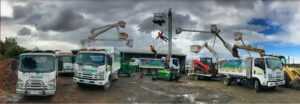
Where a tree’s canopy sits inside the clearance zones, we use one of our insulated elevated work platforms rather than sending a climber up on ropes near the line. The towers are rated to work with and around live conductors, maintained in our own workshop and electrically tested every six months, with the certificate travelling on the truck. The operator works from the basket, which gives precise control over exactly where each section lands — important when the canopy is tangled through the wires themselves.
It’s slower and more deliberate work than a straightforward removal, which is part of why access near power lines moves the price — but it’s not a job we ever cut corners on.
What actually happens on the day
On a job inside the clearance zones, the insulated platform sets up first, and if the work falls in the Spotter Zone, a registered spotter is on site the whole time watching the clearance between the machine, the tree and the line. The operator works the cut from the basket rather than climbing, bringing sections down under control rather than dropping them. It’s a slower, more deliberate pace than a standard removal — which is the trade-off for doing the job safely rather than not doing it at all.
What to tell us when you call
If the tree is anywhere near a line, say so up front — roughly how close the canopy is to the wire, and whether it’s a single line or several. That’s what lets us bring the right machine on the day rather than turning up under-prepared. If you’re not sure how close is close, a photo is usually enough for us to make the call.
What a spotter actually does
A registered spotter isn’t just someone standing nearby — it’s a specific, trained role focused entirely on the clearance between the work and the line, watching continuously while the platform or any part of the tree moves near the Spotter Zone. Their job is to call a stop the moment clearance narrows past what’s safe, before it becomes a problem rather than after. On a job where the canopy genuinely sits inside 3.0 to 6.4 metres of the line, the spotter is there for the entire operation, not just the trickiest-looking moment.
What “network operator permission” involves
Inside 3.0 metres, the relevant electricity distribution business has to sign off before work goes ahead. In practice, this usually means notifying them of the job, the location and the nature of the work, and following whatever conditions they set — which can include a temporary de-energisation of the line for the duration of the work, additional insulating barriers, or a requirement that only appropriately licensed people are within the zone. The timeline for this varies, so if your tree is inside that inner zone, it’s worth telling us as early as possible rather than expecting same-day access — we manage the network notification as part of the job, but it isn’t always instant.
How our towers earn the insulated rating
Being “insulated” isn’t a one-off label — it’s a rating that has to be maintained. Our towers are electrically tested every six months in our own workshop, and the results travel with the truck as a certificate a site supervisor or network representative can check on the day. Insulation testing and elevated work platform standards in Australia are governed by recognised Australian Standards covering both the platform itself and how it’s used near electrical hazards, which is the same framework our maintenance schedule is built around rather than something we do informally.
A worked example
A large tree with several limbs draped directly across a single-phase line running along a rear boundary — a common Gippsland scenario on older rural blocks. Because parts of the canopy were inside 3.0 metres of the conductor, the job needed the network operator’s sign-off before work started, plus a registered spotter for the full operation once approved. The platform worked the limbs back from the outside in, clearing each section fully before moving closer to the line, rather than starting near the wire and working outward. It took longer than a standard removal of the same size tree, entirely because of that sequencing — which is exactly the kind of time difference reflected in the quote for a job like this.
Frequently asked questions
Can you remove a tree that’s touching power lines?
Yes, using one of our insulated elevated work platforms rated for work with and around live conductors. The approach is more deliberate than a standard removal, but it’s routine work for us.
Do you need the power turned off?
Not always — that’s exactly the point of an insulated, rated machine. Whether a shutdown is needed depends on the clearance and the network operator’s own rules for that specific line, which we confirm before the job.
What is a “spotter” and do I need to arrange one?
A registered spotter watches the work whenever it’s happening between 3.0 and 6.4 metres from the line. We supply this as part of the job — it’s not something you need to arrange yourself.
Does this cost more than a standard removal?
Usually, yes — it takes longer and needs a rated machine rather than a straightforward drop. It’s one of the access factors we walk through when we quote.
What if it’s not our tree causing the problem, but a neighbour’s?
Tell us the situation when you call and we’ll talk you through it — that’s a conversation worth having on the phone rather than guessing here.
What does a registered spotter actually watch for?
Continuous clearance between the machine, the tree and the line for the whole operation, calling a stop the moment it narrows past a safe distance — not just watching the trickiest-looking part of the job.
How far in advance do you need to arrange network operator permission?
It varies by network and the specifics of the job, so tell us as early as possible rather than expecting same-day access for work inside the 3 metre zone. We manage the notification as part of the job.
Tree near a power line?
Send us a photo and roughly how close it is to the wire — we’ll bring the right machine and quote it free on site.
Related reading: How much does tree removal cost in Gippsland? · Insulated EWP hire · EWP spotter requirements in Victoria
Sources & references
- Energy Safe Victoria — No Go Zones: distribution overhead powerlines: Sets out the three clearance zones. Outside 6.4m, standard regulation applies with no further requirement. Between 3.0m and 6.4m, “a registered Spotter is required” – the Spotter Zone. Inside 3.0m, “permission from the relevant network operator is required and additional preventative measures will need to be taken”.
- Energy Safe Victoria — Keeping tree industry workers safe around powerlines: States that “Energy Safe recommends private tree contractors maintain the No Go Zone 3m exclusion zone”, and that private contractors must comply with Victoria’s Electricity Safety (General) Regulations 2019.
A note on this guide: clearance rules and network operator requirements can vary by situation. This is general information, not a substitute for an on-site assessment — we confirm the exact approach for your tree when we quote.
For how we handle this and what it costs, see our tree removal page.