
The short answer on tree removal cost
Across Gippsland, a straightforward removal of a small-to-medium tree with good access starts around $1,100–$1,200 plus GST. A larger tree of 12–17 metres with good access is more like $2,000–$2,500 plus GST, and a big 19-metre-plus tree with tight access and heavy chipping can run $4,000–$5,000 plus GST. The single thing that moves those numbers most is access — how close we can get the truck, the chipper and the machinery. Every quote is free and worked out on site.
“How much to take that tree out?” is the first question everyone asks, and most tree companies dodge it. We would rather explain it honestly, because once you understand what actually sets the price you can see why a quote is what it is — and why the cheapest number is not always the cheapest job. Here is how tree removal is priced across the Latrobe Valley and Gippsland, in real scenarios, from a crew that quotes these jobs every week.
Access is the number-one thing that sets the price
Before size, before species, before anything, it comes down to access. Can we get the truck and the chipper close to the tree, or does every branch have to be carried thirty metres to the street? Is there a wide gate, or a 900 mm side path with a corner in it? The same tree is a very different job — and a very different price — depending on how we can get to it. Good access means the crew and the machinery do the work; poor access means people do the carrying, and time is what you pay for.
That is why a firm price needs eyes on the job. Two identical gum trees, one in an open front yard and one behind a house with a narrow gate, can differ by more than a thousand dollars. When we quote free on site, most of what we are reading is the access.
Real scenarios, and roughly what they cost
It is easiest to talk in scenarios. A small-to-medium tree with good access — something the crew can get at and chip on the spot — starts around $1,100–$1,200 plus GST. Step up to a larger tree in the 12–17 metre range, still with good access, and you are looking at more like $2,000–$2,500 plus GST. A big 19-metre-plus tree with tight access and a lot of chipping to do can run $4,000–$5,000 plus GST. Those figures all assume we can get the gear reasonably close; they move when the job gets awkward.
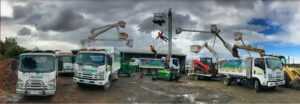
What makes a job awkward, and adds to the number? A tree hard over the house or the fence, where every limb has to be roped down in controlled sections rather than dropped. A tree close to live power lines, which needs an insulated machine and a careful approach. A crane pick where there is genuinely no other way to get the weight out. And grinding the stump as well — which is usually cheaper done in the same visit than bringing a machine back later. On the biggest and tallest jobs we can bring a 42-metre platform that reaches where a climber and a smaller tower cannot, and that reach is part of why nothing is out of range for us.

“We were given exceptional service by the guys who came to do the clean up. All the branches were chipped up and taken away… The trees were quite tall and in a location with poor access and surrounded by our garden trees. The team took them down in sections without damaging surrounding trees, an excellent job.”
Alan Fullard, Traralgon — Google review
Climbing, or the platform: how we get it down
There are two ways a tree actually comes down, and which one we use is decided by the same thing that decides the price — access. On open ground with good access, a qualified climber goes up on ropes and takes the tree apart from the top down, section by section, while the crew below feeds the chipper. It is the faster, more direct method when there is nothing in the way.
Where the access is tight, the canopy is over a house or fence, or the tree is close to power lines, we bring one of our insulated elevated work platforms instead. The operator works from the basket rather than the tree itself, which gives precise control over where every section lands — important when there is a roof, a shed or a neighbour’s fence directly underneath. Either way, the site finishes the same: cleared, chipped, and tidy.

Working near power lines
Energy Safe Victoria sets three zones around an overhead distribution powerline. Outside 6.4 metres there are no special requirements beyond standard regulation. Between 3.0 and 6.4 metres — the “Spotter Zone” — a registered spotter is required to watch the work [1]. Inside 3.0 metres, permission from the relevant network operator is required and further precautions apply [1]. For private tree work, Energy Safe recommends maintaining that 3 metre exclusion as standard practice [2].
That is exactly the situation our insulated fleet exists for. Where a tree’s canopy sits inside those zones, we use an elevated work platform rated and insulated for the job rather than sending a climber up on ropes near a line. It is slower and more deliberate work, which is part of why access near power lines moves the price — but it is not a job we ever cut corners on.
Why the cheapest quote is not always the cheapest job
A low number from an operator without the right insurance, the right machine or a qualified arborist can cost far more than it saves if a limb goes through a roof or the job stops halfway. We are fully insured, with qualified arborists on the crew and our own machines maintained in our own workshop, so the job that starts is the job that finishes, cleanly. When you compare quotes, compare what is actually included: the clean-up, the stump, the insurance, and whether the same crew that quotes is the crew that turns up.
It is also worth asking who is actually turning up. A crew without their own elevated work platform has to sub-hire one for a tight or near-power-line job, which adds cost and a second company’s schedule to yours. Ours is our own fleet, maintained in our own workshop, so a job that needs the platform is never waiting on someone else’s truck being free.
What is included, and what happens to the wood
Our removals leave the site cleaner than we found it. Branches are chipped on site, the debris is cleared, and the wood is yours to decide on — chipped for mulch, cut for firewood, or taken away. If you want the stump gone too, we grind it below the surface so you can turf, pave or plant over the top. It is all part of the same conversation when we quote.
If you would rather keep some of it, that is easy to arrange. We run our own clean mulch — nothing but that week’s own tree work, separated before the mulcher so no palms, no dirty soil and nothing that will grow back as a weed — at around $25 plus GST per cubic metre, delivered by distance. Firewood off the same jobs is also available by the cubic metre if you would rather have it cut and stacked than carted away. Just say so when we quote and we will build it into the job.
Permits: when your council needs to know
Most straightforward removals on residential blocks in the Latrobe Valley and Gippsland do not need a planning permit. Where one can apply is when a tree sits inside a Vegetation Protection Overlay or a Significant Landscape Overlay in your council’s planning scheme, or where native vegetation clearing rules apply on a larger rural property. These overlays and the trees they protect vary from council to council and even street to street [5], so the honest answer is always: check with your council before you book, and ask us if you’re not sure how.
If a permit application needs a qualified opinion on a tree’s condition or risk, that’s exactly what our arborist reports are for.
Where we do this work
Tree removal across the Latrobe Valley — Traralgon, Morwell, Moe, Churchill and Newborough; through Baw Baw — Warragul, Drouin, Yarragon and Neerim South; across Wellington Shire — Sale, Maffra, Rosedale, Stratford, Heyfield, Woodside and Yarram; and into South Gippsland — Korumburra, Foster, Mirboo North and Venus Bay. Not on the list? We still cover it — give us a call.
Frequently asked questions
How much does tree removal cost in Gippsland?
As a guide, a small-to-medium tree with good access starts around $1,100–$1,200 plus GST; a 12–17 metre tree with good access is more like $2,000–$2,500 plus GST; and a big 19-metre-plus tree with tight access and heavy chipping can run $4,000–$5,000 plus GST. Access is the biggest single factor, so every quote is free and worked out on site.
Why do you need to see the tree to give a price?
Because the same tree can be very different money depending on access, what it is over, and what has to happen on the day. A tree in an open yard and the same tree behind a narrow gate can differ by more than a thousand dollars. Seeing it is how we give you a firm, honest number rather than a guess.
Does the price include the stump and the clean-up?
Clean-up is always included — the site is left tidy and the debris chipped or removed. Stump grinding is usually quoted as part of the same job, and doing it in the one visit is generally cheaper than bringing a machine back later. Just ask when we quote.
Do you climb the tree or use a machine?
Whichever the access calls for. Open ground with a clear run gets a climber on ropes, which is usually the faster option. Tight access, a canopy over a structure, or a tree near power lines gets one of our insulated elevated work platforms instead, for more precise control over where each section lands.
Can you remove a tree near power lines or over the house?
Yes. Trees over a house are dismantled in controlled sections, and for work near live power lines we use one of our insulated elevated work platforms so it is done safely, keeping clear of Energy Safe Victoria’s No Go Zone around the line. Both add time compared with a straightforward drop, which is reflected in the quote.
Do I need a permit to remove a tree?
It depends on your council and the tree — some councils protect certain species or sizes under a Vegetation Protection Overlay or similar. It is worth checking with your local council before booking, and if you need a qualified opinion for a permit we also prepare arborist reports.
What if the tree is dead, storm-damaged or looks unsafe?
Tell us that when you call — a dead or storm-damaged tree can change how it needs to be approached and how quickly we can get to you. We still quote free on site; a hazardous tree just gets prioritised.
How long does a tree removal take?
A straightforward small-to-medium removal with good access is often done within a day. Bigger trees, tight access, or a job that needs the platform take longer — we will give you a realistic timeframe with the quote, not just a price.
Want a real number for your tree?
Send us a photo or have us out for a look — the quote is free, and we will tell you exactly what it will cost, plus GST, and why.
Related reading: Tree removal across Gippsland · Stump grinding cost: what sets the price · Arborist reports · EWP spotter requirements in Victoria
Sources & references
- Energy Safe Victoria — No Go Zones: distribution overhead powerlines: Sets out the three clearance zones. Outside 6.4m, standard regulation applies with no further requirement. Between 3.0m and 6.4m, “a registered Spotter is required” – the Spotter Zone. Inside 3.0m, “permission from the relevant network operator is required and additional preventative measures will need to be taken”.
- Energy Safe Victoria — Keeping tree industry workers safe around powerlines: States that “Energy Safe recommends private tree contractors maintain the No Go Zone 3m exclusion zone”, and that private contractors must comply with Victoria’s Electricity Safety (General) Regulations 2019.
- WorkSafe Victoria — Elevating work platforms: Covers employer duties to eliminate or reduce EWP-related risk, the role of a safety observer trained “in the emergency rescue procedures for the specific EWP(s)” they are observing, and points to the Elevating Work Platforms industry standard (Edition 4) for safe selection and use.
- Safe Work Australia — Model Code of Practice: Managing risks of plant in the workplace: The national code covering how plant such as elevating work platforms is selected, used and maintained safely across Australian workplaces, including tree work sites.
- Whitehorse City Council — Tree controls, removal, lopping and pruning: A worked Victorian example of how tree protection reaches beyond the trunk. A planning permit is required to remove, destroy or lop a tree protected by a Vegetation Protection Overlay, and within the relevant Significant Landscape Overlays a permit is also required for works within four metres of a protected tree. Controls differ between councils, so the address decides it.
A note on the figures: the prices above are honest guide ranges for the Latrobe Valley and Gippsland, based on the jobs we quote every week. They assume reasonable access and are quoted plus GST. Every job is different, so we give you a firm price free, on site. The permit and powerline-clearance information above is general guidance, not a ruling on any specific tree or property — always confirm with your council or the relevant network operator.