The short answer
Formative pruning shapes a young tree’s structure early, before problems set in. Reduction pruning takes size and weight off an established tree without removing it. Dead-wooding removes dead, dying or diseased limbs for safety, leaving the healthy canopy alone. They’re different jobs with different goals — which one you need depends on the tree’s age and what you’re actually trying to fix.
“Pruning” covers a lot of different work, and knowing which kind you actually need helps you have a much more useful conversation with whoever quotes it. Here’s what the three most common types actually involve.
Formative pruning: shaping a young tree
Formative pruning happens early in a tree’s life, while it’s still young enough that a few careful cuts can guide how it grows for decades. The goal is a strong, well-spaced branch structure — removing competing leaders, crossing branches and weak forks before they become permanent weaknesses. It’s the cheapest and most effective pruning you’ll ever do on a tree, precisely because it happens before problems exist rather than after.
Reduction pruning: taking size off an established tree
Reduction pruning reduces an established tree’s overall size or spread — often because it’s grown into a roof line, a power line, or simply bigger than the space allows — without removing the tree altogether. Done properly, cuts are made back to a lateral branch or growth point large enough to take over, rather than leaving stubs. Done badly (a flat “topping” cut straight across the canopy) it triggers weak regrowth and can shorten the tree’s life — which is why reduction is a skilled job, not just “make it smaller”.
Dead-wooding: removing what’s already dead
Dead-wooding is exactly what it sounds like: removing dead, dying, diseased or damaged limbs while leaving the rest of the healthy canopy untouched. It’s primarily a safety job — a dead limb over a driveway, a play area or a fence line is a real risk regardless of how healthy the rest of the tree is — and it’s also good tree health practice, since dead wood can be an entry point for decay and pests that spread into healthy tissue.

Which one does your tree need?
Often it’s more than one at once — an established tree near a power line might need both reduction and dead-wooding in the same visit. The honest answer depends on the tree’s age, its condition, and what you’re actually trying to achieve, which is exactly why we look at the tree before quoting rather than pricing “pruning” as one generic job.
Why the cut itself matters as much as the type
Whichever type of pruning a tree needs, how the individual cuts are made decides whether it heals cleanly or not. A proper cut is made back to a lateral branch, a bud, or the branch collar — the slightly swollen area where a branch joins the trunk — rather than leaving a bare stub. A stub can’t heal over properly and becomes an entry point for decay, which is exactly what good pruning is meant to prevent. It’s the difference between pruning that helps a tree and cutting that just makes it smaller for a season before causing problems.
Access decides the method here too
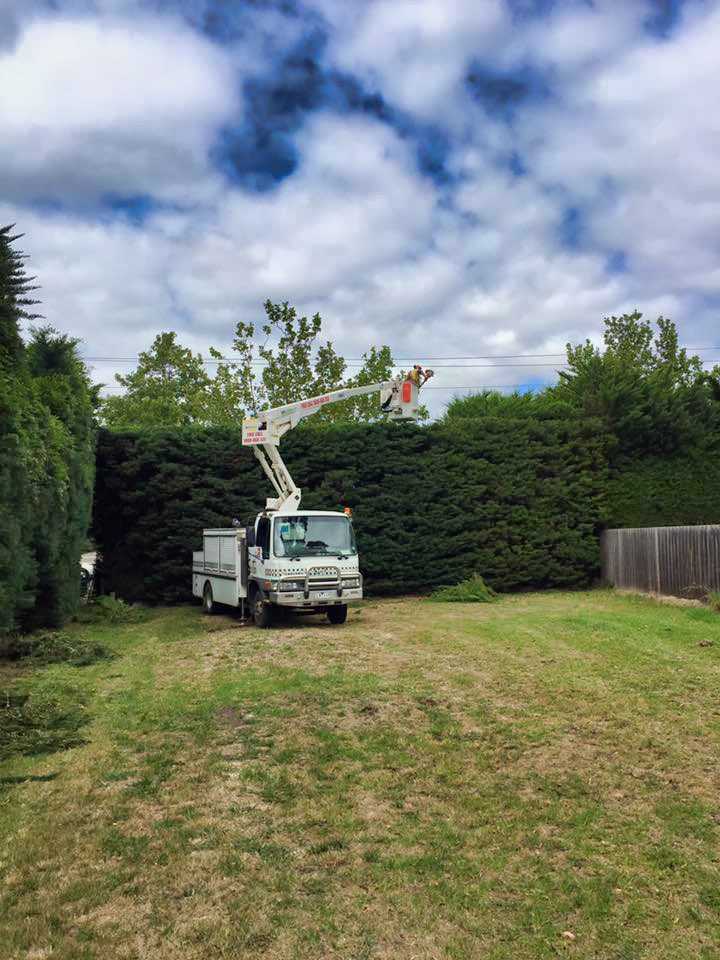
The same access logic that applies to a full tree removal applies to pruning. A tree with a clear run gets worked from the ground or by a climber; a tree that’s tall, awkward, or close to a structure or power line often calls for one of our insulated elevated work platforms instead, for the same reason it would on a removal — precise control over exactly where each cut and each piece of falling material ends up.
The standard behind proper pruning
Australian arboriculture practice for pruning amenity trees is guided by a recognised national standard covering exactly this kind of cut-point discipline — where cuts should be made, how much foliage can safely be removed in one visit, and what constitutes acceptable versus poor practice. It’s the same underlying framework a qualified arborist is trained against, and it’s the reason “how much can you take off” has a real, considered answer rather than being purely a matter of preference. Removing too much canopy in one visit can stress a tree significantly, regardless of which type of pruning is being done.
Timing: when to prune in Gippsland
The right time to prune depends heavily on the species and the goal. Many deciduous species are best pruned during dormancy in winter, when the structure is easiest to see without leaf cover and the tree isn’t actively channelling energy into new growth. Flowering species are usually pruned just after flowering finishes, so next season’s flower buds aren’t accidentally removed. Dead-wooding can generally happen any time, since it’s removing material that’s already dead rather than living growth. If timing isn’t obvious for your tree, it’s worth asking rather than guessing — the wrong season isn’t usually harmful, but it can mean a less tidy result or a missed flowering season.
What a pruning quote actually depends on
The same factors that move a removal price apply here: access for the crew and any machinery, the tree’s height and how much of the canopy needs attention, and whether the work is near a structure or power line requiring more careful control. A young tree needing a quick formative shape is a very different job from dead-wooding a mature tree with several large dead limbs over a driveway — which is exactly why we look at the tree in person before quoting rather than pricing “a prune” as one flat rate.
Frequently asked questions
What’s the difference between pruning and lopping?
Pruning is targeted, made at proper cut points to keep the tree healthy. Lopping generally means indiscriminate cutting, often straight across branches regardless of growth points — it’s a term we avoid using for our own work because it describes a bad outcome, not a method.
Can formative pruning fix an older tree’s problems?
Not in the same way — formative pruning works because the tree is still young and flexible in how it grows. An older tree with structural issues usually needs reduction or corrective pruning instead, which is a different, more careful job.
Is dead-wooding necessary if the tree looks fine otherwise?
Often, yes, if there’s dead wood over anything you’d rather it not fall on — a healthy-looking tree can still carry dead limbs worth removing for safety alone.
Will reduction pruning damage the tree?
Done properly — cutting back to a lateral branch large enough to take over — no. Done as a flat “topping” cut, yes, it triggers weak regrowth and can shorten the tree’s life. This is exactly why it’s worth having a qualified crew do it.
How do I know which type my tree needs?
Tell us what’s prompting the job — a size concern, a safety concern, a young tree you want to set up well — and we’ll tell you which type (or combination) actually applies when we quote.
How much of a tree’s canopy is safe to remove at once?
There’s a real limit — taking off too much foliage in one visit can stress a tree significantly regardless of the type of pruning. Recognised arboriculture practice guides how much is appropriate for a given tree and situation.
Is winter the best time to prune everything?
Not always. Many deciduous species suit winter pruning during dormancy, but flowering species are usually better pruned just after flowering to avoid removing next season’s buds. Dead-wooding can generally happen any time.
Not sure what your tree needs?
Tell us what’s prompting the job and we’ll tell you the right approach — and quote it free on site.
Related reading: Tree pruning across Gippsland · Hedge trimming cost
A note on this guide: this is general information about pruning types and what they’re for. The right approach for your specific tree depends on its age, species and condition, which we assess on site before quoting.