
The short answer on land clearing Victoria rules
In Victoria you generally need a planning permit to remove native vegetation, under clause 52.17 of the planning scheme. Planted garden trees and most introduced species usually sit outside that control, but your council can still protect them through a local overlay. The order that saves money is always the same: find out what is actually growing there first, then decide how it comes out.
Land clearing sounds like a machinery question. Most of the time it is a paperwork question wearing machinery’s clothes. The excavator is the easy part, and it is the part people ring about first. The part that decides whether the job runs to plan is what is growing on the block, whether any of it is protected, and what your council and the state expect you to do before a single tree comes down.
This is a plain guide to how land clearing Victoria works: what needs a permit, what genuinely does not, where the exemptions sit, what the work involves once you are cleared to start, and what actually sets the price. It is written for landholders, builders and developers working anywhere from the Latrobe Valley to the outer east of Melbourne.
Land clearing Victoria: the permit question comes first
Victoria controls the removal of native vegetation through the planning system rather than through a separate clearing licence. The relevant control is clause 52.17 of the Victoria Planning Provisions, which applies in most rural and many semi-rural zones and requires a planning permit to remove, destroy or lop native vegetation — including dead native vegetation — unless an exemption applies [1].
Two words in that sentence do a lot of work. Native excludes a great deal of what people want cleared, because a paddock of introduced pasture grass, a row of planted cypress or a stand of willows along a creek are not native vegetation. And destroy is broader than felling. Ringbarking, poisoning, repeated slashing that prevents regeneration, and pushing soil over root zones can all count, which is why the quiet options are not the loophole they look like.
The practical consequence is that two blocks on the same road can face completely different obligations. One is covered in planted exotics and can be cleared with almost no process. The neighbour has remnant indigenous understorey that most people would call scrub, and that block needs an assessment before anything happens.
What actually counts as native vegetation
Native vegetation means plants that are indigenous to Victoria, and it includes far more than mature trees. Ground cover, grasses, shrubs and understorey all count. This surprises people, because the visual test most of us apply is “is it a tree”, and the regulatory test is nothing like that.
A paddock that reads as rough grass at a glance can carry native grassland that is both protected and, in some parts of the state, genuinely rare. A gully full of what looks like weeds can hold indigenous shrubs. The only reliable way to know is to have somebody who can identify species walk the site, which is the single most useful hour you can spend before planning a clearing job.
The corollary matters just as much: a lot of what people assume is protected is not. Planted trees in a garden, introduced species, and vegetation established as part of a crop or plantation generally sit outside clause 52.17 altogether. Plenty of jobs that landholders expect to be difficult turn out to be straightforward once the species are known.
The three assessment pathways

Where a permit is required, Victoria sorts applications into three pathways. Which one applies is decided by how many hectares are being removed and whether the vegetation is habitat for rare or threatened species, or an endangered or highly sensitive vegetation type. The pathway then sets how much information you have to supply [2].
| Pathway | Broadly applies when | What it asks of you |
|---|---|---|
| Basic | Smallest extent, lower biodiversity sensitivity | The least information. Usually mapping and a site plan |
| Intermediate | Larger extent, or more sensitive vegetation | More detail on what is there and what is affected |
| Detailed | Largest extent, or rare and threatened species habitat | A site assessment, including a habitat hectare assessment |
The lesson landholders take from that table is usually the right one. Extent and location drive the cost of the process, not the difficulty of the physical work. Clearing a small area in a low-sensitivity spot is an administrative exercise. Clearing a large area of good-quality habitat is a project with a timeline measured in months.
The exemptions that actually get used
Clause 52.17 carries a long schedule of exemptions, and a handful of them cover most of the real-world jobs we are asked about.
- Fire protection — including the bushfire clearing rights described below, and works required by a fire authority.
- Existing buildings and works — vegetation directly in the way of a lawful existing structure, road or fence line, within defined limits.
- Emergency works — where vegetation presents an immediate risk to life or property.
- Land management — certain agricultural and maintenance activities, within limits.
- Dead vegetation — but this one has a hard edge: it does not extend to a standing dead tree with a trunk diameter of 40 cm or more measured 1.3 metres above ground level [3].
- Regrowth — vegetation that has regrown since a defined date in areas used for cropping or grazing, subject to conditions.
Every one of those has boundaries, and the boundaries are where people come unstuck. An exemption that permits clearing a fence line does not permit clearing ten metres either side of it for machine access. The safe approach is to treat an exemption as a defined allowance you have to stay inside, not as a general permission that has been switched on.
The 10/30 rule, and the conditions attached to it

Victoria’s bushfire provisions give landholders defined rights to clear around a dwelling without a planning permit. In broad terms the 10/30 right allows removal of any vegetation, including trees, within 10 metres of an existing dwelling, and any vegetation except trees within 30 metres of it. A 10/50 right applies in the areas of greatest bushfire hazard, and there is a separate allowance for fence lines [4].
The conditions are where this gets misread, and they are strict. The right applies only where the building sits in an area designated as bushfire prone under the Building Act 1993. It applies to houses and fences constructed before 10 September 2009. And it applies state-wide except in 21 metropolitan municipalities. A newer house in a bushfire prone area does not attract the 10/30 right, which catches people who assume it comes with the land rather than with the building.
Two further points are worth holding onto. The right covers both native and non-native vegetation, which makes it broader than clause 52.17 in that one respect. But within the 10 to 30 metre band it excludes trees, so the canopy people most want gone is often exactly what it does not cover.
It is also worth separating two things that get conflated. Clearing for bushfire safety and clearing for a building envelope are different purposes under different rules, and using a fire-protection right to achieve a development outcome is the kind of thing that attracts attention.
Offsets: the cost nobody budgets for
Where a permit is granted for native vegetation removal, it will usually carry an offset requirement — a compensating gain in vegetation secured elsewhere, either on your own land or by purchasing credits [2]. The obligation is real, it has a price, and it is frequently the largest single line in a clearing budget.
Offset cost varies enormously with what is being removed and how rare it is. This is the part of the job we cannot quote and neither can any contractor, because it is set by the assessment rather than by the work. What we can tell you plainly is that on a permitted native clearing job, the offset can exceed the cost of the physical clearing, and a budget built only around machinery hours will be wrong.
Where councils add their own layer
State controls are the floor, not the ceiling. Individual councils apply overlays that add protection on top of clause 52.17, and these routinely catch vegetation the state controls do not.
The common ones are the Significant Landscape Overlay, the Environmental Significance Overlay, the Vegetation Protection Overlay and the Bushfire Management Overlay. An overlay can protect a planted exotic tree that has no native status whatsoever, purely because of its contribution to the landscape or its heritage value. Some councils also maintain significant tree registers with their own consent requirements.
This is why a general answer about Victorian rules only gets you so far. The specific answer lives in the planning scheme for your property, and you can check which overlays apply to a given address through the state’s free property report service [4].
Noxious weeds change the obligation entirely
Some species come with a duty to remove rather than a restriction on removing. Under the Catchment and Land Protection Act 1994, certain plants are declared noxious weeds and sorted into four categories, and the category determines what the landholder must do [5]. Blackberry, gorse, ragwort and spear thistle are generally regionally controlled, which places a duty on the land owner to take all reasonable steps to prevent their growth and spread.
These are the ones we meet most often on Gippsland and outer-eastern properties. If a block is carrying a declared weed, clearing stops being optional and the method matters, because the wrong approach spreads material rather than removing it. Mulching a stand of blackberry on site and leaving the mulch where it fell is an efficient way to plant more blackberry.
What land clearing actually involves on the ground

Once the paperwork is settled, the physical job breaks into a small number of decisions that between them set the timeline and the cost.
The first is what has to come out whole and what can be processed where it stands. Anything near a boundary, a structure, a driveway or a service line comes down in controlled sections. Open ground in the middle of a block is a different job entirely, and it is where the machinery earns its keep.
The second is what happens to the material. On a cleared hectare the volume of green waste is much larger than people picture, and moving it is often the most expensive thing that happens all week.
Tell us what is on the block. We will tell you what it takes.
A site visit and a free written quote, anywhere from the Latrobe Valley to Melbourne’s outer east. If the block needs a permit we will tell you that before you spend anything.
Mulching on site, or carting away
Processing material where it falls is almost always cheaper than trucking it off. A chipper turns branch material into uniform woodchip in one pass, and that chip has somewhere useful to go: spread as ground cover, stockpiled for later, or taken away for use elsewhere. Our wood chipping service exists precisely because the alternative is paying to cart volume.
Two things decide whether on-site processing is the right answer. Do you want the chip? Spread material suppresses weeds and holds moisture, which is a real benefit on a block you are about to plant or leave fallow, and a nuisance on one you are about to build on. And is the material clean? Chipping a declared weed and leaving the mulch in place spreads the problem, as does chipping diseased timber and moving it around the property.
Where the chip is not wanted on site it becomes a product rather than a waste, which is why we also run mulch supply and firewood supply. Milling-grade and firewood-grade timber is worth separating before anything goes through a chipper, because once it is chip it is chip.
Stumps: grind, pull, or leave
What happens to stumps depends entirely on what the land is for next. There is a fuller guide to what sets a stump grinding cost if the stumps are the main job rather than part of a clearing.
If you are building, running services, or putting in a driveway, stumps come out completely and the void is backfilled and compacted. If the land is going back to pasture, grinding below the surface is usually enough and is considerably cheaper than excavating each root plate. If the block is being left, stumps can stay, though they will regrow on some species and become a hazard on others.
Grinding and full removal are genuinely different jobs with different machines and different prices, which is why stump removal is quoted separately rather than assumed into a clearing rate. Ask for it to be itemised, so you can see what you are choosing.
Access, ground conditions and the weather window
Access is the quiet variable that moves a quote more than almost anything else. A block a machine can drive onto and work across is straightforward. A block reached through a single gate, across a soft paddock, or down a slope, is a different proposition — and it is assessed at the tightest point, not the widest.
Ground conditions decide the season. Heavy plant on saturated Gippsland clay does damage that takes longer to repair than the clearing took to do, so wet-weather work is often better deferred than pushed through. In the other direction, the Fire Danger Period changes how the work is done. Machinery with an internal combustion engine is still permitted in dry vegetation, but only on conditions: the equipment must be free of faults that could start a fire, somebody must be in attendance the whole time it is running, and fire suppression equipment must be on hand — a knapsack spray pump in working order of at least 9 litres, or a water extinguisher of equivalent capacity. Where those conditions cannot be met, the work needs a permit [6].
The practical planning point: the best windows for land clearing in this part of Victoria are usually autumn and early spring, when the ground carries plant and the fire restrictions have lifted.
What sets the price

A handful of things move a land clearing quote, and access is only one of them. On a native clearing job the permit and any offset is frequently the largest single cost, and it is set by the assessment rather than by us. The volume of material decides how much processing and how many truck movements are involved, and where that material goes is a real lever: chipped on site is the cheapest option, while carting it off is the expensive one. Access is measured at the tightest point and decides which plant can be used at all, and work near buildings, boundaries or power lines is slower and needs different controls. Stump treatment is three different prices depending on whether they are left, ground or fully excavated. And the terrain matters — slope and wet ground change both the machine and the day rate.
Anyone quoting land clearing over the phone, sight unseen, is guessing at every row of that table. A number given without a site visit is not a quote, and the gap between the guess and the invoice is where disputes come from.
Power lines change the method
Where vegetation sits near live conductors, the job stops being a clearing job and becomes an electrical-clearance job with clearing attached. Victoria applies mandatory No Go Zone distances around live apparatus, and the required controls escalate as you get closer. Depending on the voltage and the distance, the work may need a registered spotter, an insulated machine, or the line made safe by the operator.
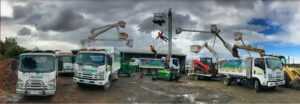
We run a fleet of insulated elevated work platforms from 12.8 m to 23.5 m working height for exactly this reason, and the detail is covered properly in our guide to spotter requirements in Victoria. If there is a line anywhere near the block, say so when you ring — it changes the plan, and it is much cheaper to plan for than to discover.
What to have ready before you ring
- The address, so overlays can be checked against the planning scheme.
- Roughly what area you want cleared, and what it is for afterwards.
- Whether you know of any native vegetation on the block, and whether it has been assessed.
- Where the access is, and the width at the narrowest point.
- Whether there are power lines, easements or services on or near the site.
- Whether you want the chip left on site or taken away.
- Your timing, and whether it is flexible around ground conditions.
What a proper quote includes
A quote worth comparing is itemised. It should separate the clearing itself, the processing of material, stump treatment, any carting, and traffic management if the work touches a road. It should state what is not included — permits and offsets almost never are — and it should be written down.
Where a job needs formal advice on tree condition, retention or the impact of works on trees that are staying, that is an arborist report and a separate piece of work. Councils frequently ask for one as part of a permit application, and having it prepared early is usually faster than being asked for it midway through an assessment.
Which service the job actually needs
Land clearing is one of several things people mean when they ring about a block. Matching the right service to the job is most of the value of the first conversation.
- Land clearing — the whole block, or a defined area of it, taken back for a new use.
- Vegetation management — ongoing control along easements, boundaries and access tracks rather than a one-off clear.
- Tree removal — specific trees, usually near something that makes the work delicate.
- Tree pruning — retaining the tree and reducing the problem.
- Excavation — what usually follows clearing, once the ground is being shaped for its next use.
- Traffic control — required where the work affects a road or footpath.
Land clearing across Gippsland and Victoria
We work across the Latrobe Valley, Gippsland, and out through Melbourne’s eastern and south-eastern fringe. The plant travels, and on larger rural jobs the travel is a small part of a week’s work rather than a reason to look local first.
If you are not sure whether your block needs a permit, that is the conversation to have first, and it costs nothing. We would rather tell you the job needs an assessment than take a deposit for work that cannot legally start.
Frequently asked questions
Do I need a permit for land clearing in Victoria?
Does native vegetation only mean trees?
What is the 10/30 rule?
What is an offset and will I have to pay for one?
Can I clear introduced trees without a permit?
How do I find out what applies to my property?
What happens to all the material?
Should I have the stumps ground or dug out?
Can you clear during the fire danger period?
There are power lines over the block. Does that change anything?
What about blackberry, gorse and other weeds?
How long does a permit take?
Do you quote over the phone?
Do you do the permit application for me?
Sources & references
- DEECA Victoria — Native vegetation: The state’s overview of native vegetation controls, confirming that clause 52.17 of local planning schemes is a statewide provision requiring a permit to remove, destroy or lop native vegetation, including dead native vegetation, unless an exemption applies.
- DEECA Victoria — Native vegetation removal regulations: Sets out the three assessment pathways (Basic, Intermediate and Detailed), which are determined by the area of native vegetation removed and whether it is habitat for rare or threatened species or an endangered vegetation type, and explains how removal is offset against the goal of no net loss to biodiversity.
- DEECA Victoria — Exemptions from requiring a permit: The schedule of exemptions under clauses 52.16 and 52.17, including the dead vegetation exemption and its limit: it does not apply to a standing dead tree with a trunk diameter of 40 cm or more at 1.3 metres above ground level.
- Planning Victoria — Vegetation removal for bushfire protection: The bushfire clearing exemptions, including the 10/30 rule, the 10/50 rule and fence line clearing. Confirms the exemptions apply to bushfire prone areas, to houses and fences constructed before 10 September 2009, and state-wide other than in 21 metropolitan municipalities.
- Agriculture Victoria — Invasive plant classifications: The four categories of noxious weed declared under the Catchment and Land Protection Act 1994, and what each category requires of a land owner. Widespread species such as blackberry and ragwort are regionally controlled, obliging owners to take all reasonable steps to prevent their growth and spread.
- CFA Victoria — Can I or can’t I?: What may and may not be done during the Fire Danger Period. Machinery with an internal combustion engine may be used in dry vegetation provided it is free of defects, a person is in attendance throughout, and fire suppression equipment of at least 9 litres is carried; otherwise a permit is required.
This guide is general information about how vegetation controls work in Victoria. It is not planning or legal advice, and the controls that apply to any particular property depend on its zone, its overlays and what is growing on it. Check the planning scheme for your address, and speak to your council before clearing.