The short answer on hedge trimming cost
A hedge that’s already kept under control — trimmed on a regular schedule — typically runs $3,000–$4,000 plus GST for a standard job (around 100 metres long, 6–7 metres wide, 10–12 metres tall, face and top only). Let the same hedge get away from you on all four sides, needing hand work off ladders, and the number changes completely — it can run into the tens of thousands. Maintenance is what keeps the price sane.
Hedge pricing surprises people more than almost anything else we quote, because the same hedge can cost wildly different amounts depending on how long it’s been left. Here’s why, in real numbers.
A standard maintained hedge
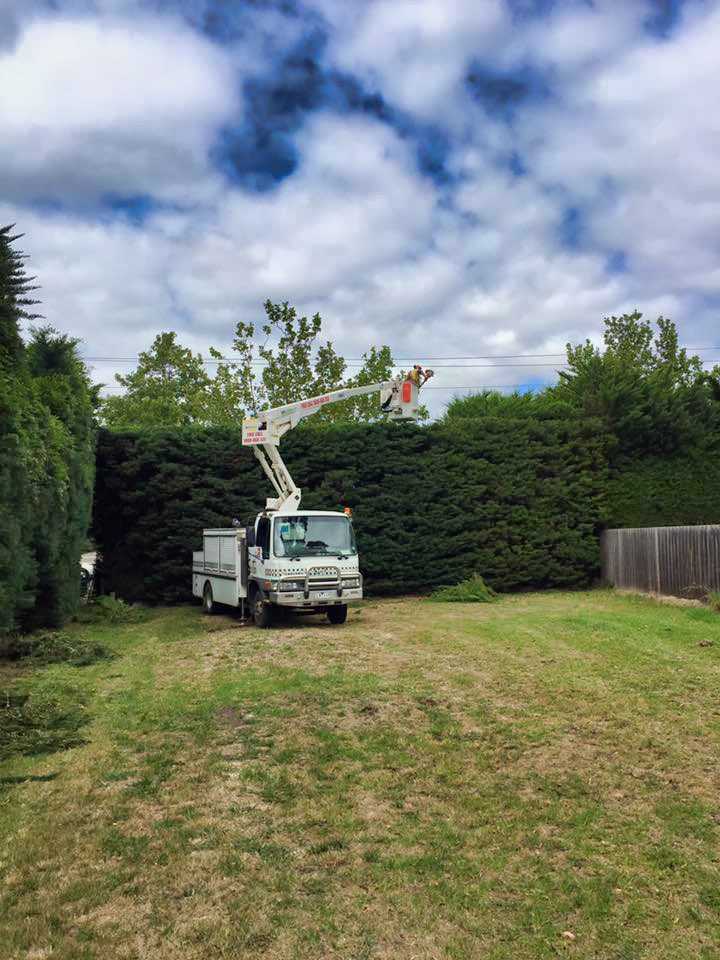
Our standard reference job is a hedge around 100 metres long, 6–7 metres wide and 10–12 metres tall — a substantial established hedge, not a small garden border. Trimmed on the face, the ends and the top only (the back is never touched, which is standard practice for a hedge against a fence line or boundary), a hedge like this that’s genuinely kept under control — trimmed on a regular schedule, not left to grow out between visits — runs around $3,000–$4,000 plus GST.
The same hedge, left to get away from you
Now take that same size hedge and let it go. If it’s grown out on all four sides rather than three, and one side needs to be done by hand off ladders because a machine can’t reach it safely, the job stops being a routine trim and becomes a much bigger undertaking — more time, more labour, more risk management for the crew working at height by hand instead of from a machine. That job can run to tens of thousands of dollars rather than a few thousand — the exact opposite end of the range from the maintained version of the same hedge.
The gap between those two numbers is the real lesson here: it isn’t the hedge that costs the money, it’s how long it’s been since anyone touched it.
Why maintenance is the lever that matters most
A hedge trimmed on a regular schedule stays a machine job — predictable access, predictable time, predictable price. Once it’s grown past what a machine can safely reach on every side, sections have to be done by hand, off ladders, one person at a time, which is slower and carries more risk than working from the ground or a platform. That’s the entire reason the price moves as much as it does — not the hedge itself, but what it takes to get at it.
If your hedge has gotten away from you, the honest advice is: get it back under control now rather than letting it go further. Every season it’s left adds to what the eventual job costs.
What actually happens on the day
For a maintained hedge, it’s a straightforward machine job: trim the face, ends and top back to a clean line, chip the offcuts on site, and clear up. For an overgrown hedge needing hand work, the approach is more deliberate — working section by section off ladders where a machine genuinely can’t reach, checking for anything nesting in the growth before cutting into it, and taking more care with what falls and where, since a much larger volume of material is coming off in one visit than a routine trim ever produces.
Getting a hedge back under control
If a hedge has been left for a long time, we don’t necessarily recommend taking it all the way back to a tight maintained shape in one visit — a severe reduction all at once can shock some species and leave bare patches that take a season or more to fill back in. Depending on the hedge, it can be worth doing the worst of the overgrowth first, then bringing it fully back under control on a follow-up visit once it’s had a chance to recover. We’ll tell you which approach suits your specific hedge when we look at it.
Common hedge species and how they behave
Not every hedge grows or responds to trimming the same way. Fast growers like photinia or privet can put on significant growth in a single season and get away from a maintenance schedule quickly if it slips; conifers such as leylandii generally don’t reshoot from bare old wood the way broadleaf hedges do, so letting one get too far out of shape can mean permanent bald patches rather than just a bigger trim; and native hedging species vary widely in how hard they tolerate being cut back. Knowing which species you’re dealing with changes both how often it needs attention and how aggressively it can be safely trimmed if it has gotten away from you.
Timing matters too
Beyond how overgrown a hedge is, when it’s trimmed affects both the result and sometimes the cost. Cutting during active spring growth generally means faster regrowth covering any bare patches from a hard cut, while trimming in the wrong season for a particular species can leave visible scarring for longer, or in the case of flowering hedges, remove the coming season’s flowers entirely if the timing is wrong. We’ll factor the right timing for your specific hedge into when we recommend booking the job, not just how big a job it currently is.
A worked example
A four-sided conifer hedge that had gone several years without attention, well past what a hedge trimmer could reach from the ground on any side. Because leylandii-type conifers don’t reliably reshoot from bare wood, taking it hard back to a tight shape in one visit risked permanent bare patches on the inner growth that had never seen light. The approach was staged: bring the height and the worst of the outward growth back first, leave it a season to respond, then finish shaping it back to a maintainable size on a follow-up visit. It took two visits rather than one, but it avoided turning an overgrown hedge into a permanently patchy one.
Frequently asked questions
How much does hedge trimming cost?
A standard maintained hedge (around 100m long, 6–7m wide, 10–12m tall, face and top only) runs around $3,000–$4,000 plus GST. An out-of-control hedge needing hand work on multiple sides can run to tens of thousands — the gap comes entirely from how overgrown it’s gotten.
Do you trim the back of the hedge too?
Standard practice is face, ends and top only — the back (typically against a fence or boundary) is left untouched unless you specifically ask for it.
Why is an overgrown hedge so much more expensive?
Because it stops being a machine job. Once a hedge has grown out on every side, parts of it often have to be cut by hand off ladders rather than trimmed from the ground or a platform — slower, more labour, more risk to manage.
How often should a hedge be trimmed to stay in the cheaper range?
Regularly enough that it never grows past what a machine can reach safely on every side. The exact schedule depends on the species and how fast it grows — ask us when we quote and we’ll give you a realistic interval for your hedge.
Is every hedge priced the same way?
No — length, width, height, species and access all change the number. The figures here are for our standard reference size; we quote your actual hedge on site.
Can any overgrown hedge be cut back to size in one visit?
Not always safely. Some species, particularly conifers, don’t reshoot well from bare old wood, so a severe cut can leave permanent bare patches. We’ll tell you if your hedge needs a staged approach rather than one hard cut.
Does the time of year affect the price or the result?
It can affect the result more than the price directly — the right season for your hedge species means faster, more even regrowth after a hard trim. We’ll factor this into when we recommend booking.
Hedge gotten away from you?
The sooner it’s back under control, the cheaper it stays. Free quote, no obligation.
Related reading: Tree pruning across Gippsland · How much does tree removal cost in Gippsland?
A note on the figures: the prices above are honest guide ranges based on the jobs we quote every week, for a standard reference hedge size. They assume the access and condition described and are quoted plus GST. Every hedge is different, so we give you a firm price free, on site.
If a tree is past saving, see what tree removal involves.